
Introduction
Graphene coating is one of those terms that's shown up everywhere in the detailing world over the last few years, plastered across shop windows and Instagram reels, usually with words like "next-generation" and "revolutionary" attached to it. If you're a car owner in Thrissur trying to figure out whether it's worth the investment, or whether it's just ceramic coating with better marketing, you're asking the right question.
The honest answer sits somewhere in the middle. Graphene coating is a real, legitimate advancement in protective coating technology, not a gimmick, but it's also not some miracle product that makes your car invincible. Understanding what it actually is, how it's different from standard ceramic coating, and what it realistically does for a car driving through Thrissur's monsoons, heat, and dusty roads is what actually matters before you spend money on it.
This guide breaks graphene coating down properly: what it is, how it works, how it compares to ceramic coating, and how to judge whether it's the right call for your specific car.
Quick Answer
Graphene coating is a protective liquid coating that incorporates graphene, a highly conductive carbon material, into a ceramic-based formula. It offers similar core benefits to standard ceramic coating, gloss, hydrophobic water beading, and easier cleaning, with the added advantage of improved heat dissipation and generally enhanced durability. It doesn't replace the need for proper paint correction beforehand, and it still won't stop physical damage like stone chips or scratches.
1. What Is Graphene Coating, Really?
Graphene coating is a protective automotive coating that incorporates graphene, a single layer of carbon atoms arranged in a hexagonal lattice, into a ceramic-based liquid formula. It's applied the same way traditional ceramic coating is: by hand, in thin layers, onto a properly prepared paint surface, where it bonds with the clear coat to form a hard, protective layer.
Graphene itself isn't new technology in the broader world; it's been studied extensively in materials science for its strength, conductivity, and thermal properties. What's relatively newer is its application in the automotive detailing space, where manufacturers blend graphene into coating formulas to enhance certain properties beyond what standard silicon dioxide (SiO2) ceramic coatings offer on their own.
It's worth being clear about one thing upfront: graphene coating is still fundamentally a ceramic coating. It's not an entirely separate category of product. Think of it as an evolution within the ceramic coating family, not a replacement technology that makes standard ceramic coating obsolete.
2. How Graphene Coating Actually Works
Like standard ceramic coating, graphene coating chemically bonds with your car's clear coat during the curing process, forming a dense, uniform layer on top of the factory paint. This bonded layer is what creates the coating's core benefits: increased surface hardness, a hydrophobic surface that repels water, and enhanced gloss from the smooth, reflective finish it creates.
The addition of graphene into the formula is generally associated with two specific advantages over standard ceramic coating:
Improved heat dissipation. Graphene is known for its thermal conductivity, meaning graphene-infused coatings are generally associated with spreading and dissipating heat more efficiently across the coated surface, rather than allowing heat to concentrate and build up.
Enhanced durability and slickness. Many graphene formulas are associated with a slightly harder, more slippery surface than standard ceramic coating, which can make it marginally more resistant to light scratching and easier to clean over time.
It's worth noting that exact performance varies by product and formula, since "graphene coating" isn't a single standardized product across the industry, different brands blend graphene into their base ceramic formula at different concentrations and with different supporting chemistry.
3. Graphene Coating vs Ceramic Coating: The Real Differences
This is the comparison most car owners actually want answered, so let's be direct about it.
What's the same: Both are ceramic-based coatings. Both require proper paint correction and preparation beforehand. Both bond chemically to the clear coat. Both offer hydrophobic water beading, added gloss, and easier maintenance. Neither one provides meaningful protection against stone chips or scratches, that's a job for PPF, not a liquid coating.
What's different: Graphene coating generally offers improved heat resistance due to graphene's thermal conductivity properties, which can be genuinely useful in a climate like Kerala's, where dark-colored cars parked in direct sun absorb significant heat. Graphene coatings are also often associated with a slightly more durable, slicker finish, though the degree of difference depends heavily on the specific product and application quality.
In practical, everyday terms, the difference between a well-applied standard ceramic coating and a well-applied graphene coating is often more incremental than dramatic. Both will noticeably improve your car's gloss and ease of maintenance compared to unprotected paint. Graphene coating is generally positioned as the more advanced, slightly longer-lasting option within that same category.
4. What Graphene Coating Can and Cannot Do
What it can do:
Add noticeable gloss and depth to the paint's finish
Create a hydrophobic surface that causes water to bead and roll off
Make routine washing significantly easier, since dirt and grime struggle to bond to the surface
Offer improved heat dissipation compared to standard ceramic formulas
Provide UV resistance that helps slow paint oxidation and fading over time
Resist mild chemical contaminants like bird droppings and tree sap, if cleaned within reasonable time
What it cannot do:
Prevent stone chips or gravel damage
Stop scratches from branches, keys, or careless contact
Fix existing swirl marks, oxidation, or scratches (it seals whatever condition the paint already has)
Replace the need for proper washing and maintenance altogether
If physical impact protection is your primary concern, graphene coating alone won't solve that; pairing it with PPF on high-impact panels is the more complete approach for that specific need.
5. The Application Process
Graphene coating follows essentially the same application sequence as standard ceramic coating, since the underlying bonding process is the same:
Wash and decontamination — removing surface dirt, embedded iron particles, and tar deposits
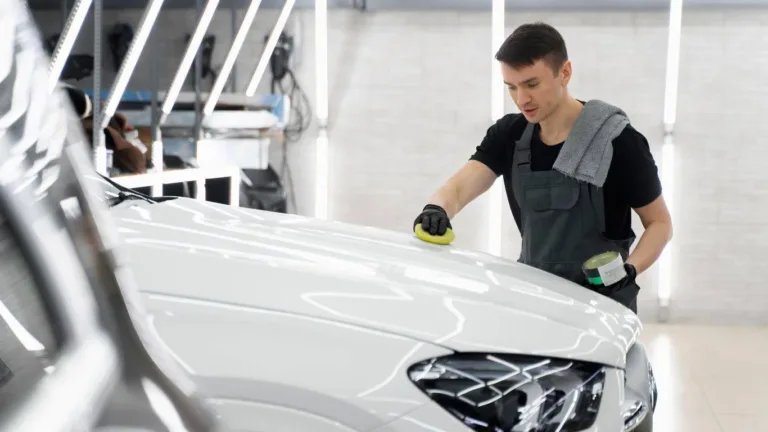
Paint correction — polishing out existing swirl marks, light scratches, and oxidation, an essential step before any coating, since skipping it locks imperfections in permanently
Surface prep and panel wipe-down — clearing away polishing oils and residue so the coating can bond properly to the clear coat
Coating application — applied in thin, even layers using an applicator, working section by section
Flash and cure time between layers — allowing each layer to properly bond before the next application
Extended curing period — full hardening continues over the following days, during which the car should avoid water exposure and harsh conditions
Skipping the correction stage is one of the most common shortcuts taken by lower-quality shops, and it's just as damaging with graphene coating as it is with standard ceramic coating, the coating will still lock in whatever condition the paint was in beforehand.
6. Comparison Table: Graphene vs Ceramic vs Standard Wax
| Factor | Standard Wax | Ceramic Coating | Graphene Coating |
|---|---|---|---|
| Bonding to paint | Temporary, sits on surface | Chemically bonds | Chemically bonds |
| Typical lifespan | Weeks to a couple of months | Roughly 2–5 years, product-dependent | Generally comparable or slightly longer, product-dependent |
| Gloss enhancement | Moderate | High | High |
| Hydrophobic performance | Moderate | Strong | Strong |
| Heat dissipation | Minimal | Standard | Improved, due to graphene's thermal properties |
| Scratch/chip resistance | None | Minimal, surface-level | Minimal, surface-level (slightly more resistant to light marring in some formulas) |
| Ease of cleaning | Improved | Significantly improved | Significantly improved |
| Cost | Lowest | Moderate | Generally the higher end of coating options |
| Requires paint correction first | Recommended | Strongly recommended | Strongly recommended |
7. Benefits of Graphene Coating
Enhanced gloss and depth. Graphene coating creates the same smooth, reflective finish that standard ceramic coating is known for, often described as giving paint a deeper, glass-like appearance.
Improved heat resistance. Thanks to graphene's natural thermal conductivity, coated surfaces are generally associated with better heat dissipation, relevant for dark-colored cars sitting in direct Kerala sun for extended periods.
Strong hydrophobic performance. Water beads and rolls off efficiently, reducing water spotting risk, particularly useful during Kerala's extended monsoon months.
Easier long-term maintenance. Because dirt struggles to bond to the coated surface, routine washing becomes noticeably faster and less labor-intensive.
Potentially enhanced durability. Many graphene formulas are associated with a slightly harder, more resilient surface compared to standard ceramic coating, though actual performance varies by specific product.
8. Common Mistakes Car Owners Make
Assuming graphene coating is a completely different product from ceramic coating. It's fundamentally a ceramic-based formula with graphene incorporated in; understanding this helps set realistic expectations rather than expecting something entirely different.
Skipping paint correction to save money. This is the single most damaging shortcut, regardless of whether you're applying graphene or standard ceramic coating, it locks in existing paint imperfections permanently.
Expecting scratch or chip immunity. Graphene coating improves surface hardness marginally, but it's still a thin chemical layer, not a physical barrier capable of absorbing real impacts.
Washing too soon after application. Both graphene and ceramic coatings need proper curing time before their first wash; rushing this can compromise the bond.
Choosing based on marketing claims alone. "Graphene" has become a popular marketing term industry-wide; it's worth asking what specific formula and concentration a shop actually uses rather than assuming all "graphene coatings" perform identically.
9. Myths vs Facts
Myth: Graphene coating is a completely different technology from ceramic coating. Fact: It's a ceramic-based coating with graphene incorporated into the formula, an evolution within the same product category, not a separate one.
Myth: Graphene coating makes your car scratch-proof. Fact: It offers marginally improved surface resilience in some formulas, but it's still a thin coating that can't stop real scratches or stone chips.
Myth: Graphene coating never needs reapplication. Fact: Like standard ceramic coating, it has a finite lifespan, generally comparable to or slightly longer than standard ceramic formulas, and eventually needs maintenance or reapplication.
Myth: All graphene coatings perform identically since they contain the same base material. Fact: Formula, concentration, and application quality vary significantly between products and shops, meaning results can differ even among products labeled "graphene coating."
Myth: Graphene coating replaces the need for PPF. Fact: It doesn't provide physical impact protection; PPF remains the appropriate solution for stone chip and scratch resistance.
10. Is Graphene Coating Worth the Extra Cost?
Graphene coating generally sits at a higher price point than standard ceramic coating, reflecting the more advanced formula and, in many cases, the additional benefits around heat resistance and durability. Whether that extra cost is worth it depends on your priorities.
If you're someone who keeps a car for years, parks frequently in direct sun, and wants the most current coating technology available with a potentially longer-lasting result, graphene coating is a reasonable upgrade over standard ceramic coating. If your budget is tighter and your main goal is simply better gloss and easier washing than bare paint, a well-applied standard ceramic coating still delivers the core benefits most owners are actually looking for.
Rather than assuming graphene is automatically "better" across the board, it's worth having a direct conversation with your detailer about your car's specific conditions, how it's parked, how often it's driven, and what you're hoping to get out of the coating, before deciding which tier makes sense for your budget.
11. Kerala-Specific Advantages of Graphene Coating
Heat management in tropical conditions. Kerala's tropical climate means cars parked outdoors absorb significant heat throughout the day, particularly darker colors. Graphene's thermal conductivity properties are especially relevant here, helping dissipate that heat more efficiently across the coated surface.
Monsoon water resistance. Thrissur's extended rainy season puts constant water exposure on parked and driven vehicles. The hydrophobic properties in graphene coating help reduce water spotting and mineral staining that heavy monsoon rain can leave behind.
Humidity-driven oxidation. Kerala's consistently high humidity accelerates paint oxidation over time on unprotected surfaces. The UV and chemical resistance offered by graphene coating helps slow this process down.
Dust from ongoing road work. Fine construction dust common around Thrissur district settles more easily onto uncoated paint. A coated surface makes safe removal considerably easier during routine washing.
Coastal humidity influence. Even for car owners further inland in the district, some coastal humidity effects still contribute to long-term paint stress, another factor where added coating protection genuinely helps.
12. Maintenance Tips for Graphene-Coated Cars
Use pH-neutral car shampoo; harsh detergents strip the coating's performance faster than proper products
Avoid automated brush car washes, which can introduce fine scratches on the coated surface
Remove bird droppings and tree sap promptly, since prolonged contact can still cause etching even through a coating
Hand dry with a clean microfiber towel after washing to prevent water spotting
Use a maintenance spray or booster product periodically to help refresh hydrophobic performance between full washes
Park in shade when possible, even with graphene's improved heat dissipation, reducing overall UV exposure still benefits long-term coating performance
13. Who Should Consider Graphene Coating
Graphene coating tends to make the most sense for:
Owners who park primarily outdoors in direct Kerala sun and want improved heat resistance
Owners planning to keep their car for several years and want the most current, potentially longer-lasting coating option
Dark-colored vehicles, where heat absorption and gloss enhancement both matter more visibly
Owners already investing in PPF on high-impact panels, looking for a matching topcoat with added thermal benefits across the rest of the car
If your budget is more limited and your main priority is simply improved gloss and easier maintenance over bare paint, standard ceramic coating remains a genuinely solid choice that covers most of the same core benefits.
14. Frequently Asked Questions
1. Is graphene coating better than ceramic coating? It's generally considered an advancement within the same category, offering improved heat dissipation and potentially longer durability, rather than a fundamentally different or universally "better" product.
2. How long does graphene coating last? This depends on the specific formula, application quality, and maintenance routine, but it's generally comparable to or slightly longer-lasting than standard ceramic coating.
3. Does graphene coating protect against stone chips? No, it's a chemical coating, not a physical barrier, so it doesn't stop stone chips or scratches the way PPF does.
4. Can graphene coating be applied over PPF? Yes, this is a common combination, adding gloss and hydrophobic performance on top of PPF's physical impact protection.
5. Is graphene coating suitable for all car colors? Yes, though the heat dissipation benefit is often more noticeable on darker colors, which absorb more heat under direct sun.
6. Does graphene coating need paint correction beforehand? Yes, just like standard ceramic coating, applying it over uncorrected paint locks in existing swirl marks and imperfections permanently.
7. How is graphene coating different from a graphene spray sealant sold in stores? Professional-grade graphene coatings are applied and cured under controlled conditions with proper prep work, while consumer spray sealants generally offer a much shorter-lived surface effect.
8. Can I wash my car normally after graphene coating is applied? Yes, once the curing period is complete, using pH-neutral shampoo and gentle hand-washing technique going forward.
9. Does graphene coating make washing easier? Yes, the hydrophobic surface it creates means dirt and water struggle to bond to the paint, making routine washing noticeably faster.
10. Is graphene coating worth it for a budget or entry-level car? It can be, particularly if you plan to keep the car for years and want long-term protection, though standard ceramic coating may be a more budget-appropriate starting point.
11. Does graphene coating actually reduce interior cabin heat? The coating itself is applied to exterior paint, so its heat dissipation benefit relates to the painted surface rather than directly cooling the cabin interior.
12. Can graphene coating be removed if I change my mind? It can be removed, though this typically requires polishing or light compounding, since it chemically bonds with the clear coat similarly to standard ceramic coating.
13. Does every detailing shop's "graphene coating" perform the same way? No, formula, graphene concentration, and application quality vary between products and shops, so it's worth asking specifically what product and process is being used.
14. Should I get graphene coating or standard ceramic coating first if I'm unsure? It depends on budget and priorities; discussing your car's specific conditions and how it's used with your detailer is the most reliable way to decide which tier fits your situation.
15. Final Thoughts
Graphene coating isn't a marketing gimmick, but it's also not an entirely separate technology from ceramic coating, it's a genuine evolution within that same product category, built around graphene's real thermal and durability properties. For Kerala car owners dealing with intense sun, extended monsoons, and constant humidity, the added heat dissipation and durability it offers can be a meaningful upgrade, particularly for cars that spend a lot of time parked outdoors.
That said, it's not a magic solution that replaces proper paint correction, careful maintenance, or physical protection like PPF where that's genuinely needed. The best results, with graphene or standard ceramic coating alike, always come down to proper preparation and application quality first, and the specific coating chosen second.
16. Call to Action
If you're considering graphene coating for your car in Thrissur and want an honest assessment of whether it's the right fit for your vehicle and driving conditions, get in touch with Menora We2 Auto Detailing Studio in Irinjalakuda or Mannuthy. We'll walk you through your paint's current condition and help you decide between graphene, standard ceramic, or a combination approach that actually fits your car.