
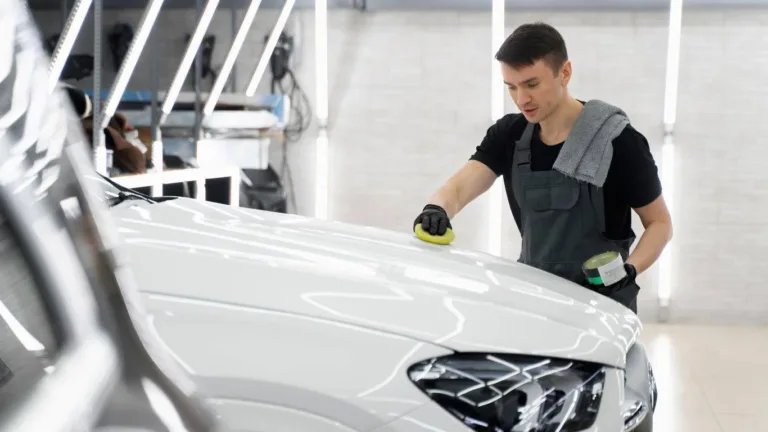
Whenever a car enthusiast drops by our detailing bay on Town Hall Road in Irinjalakuda after researching paint protection online, they almost always bring up this debate:
"Brother, I was planning to get ceramic coating done on my new car, but someone on social media told me ceramic is outdated and graphene coating is 200 times stronger than steel. Is graphene coating genuinely better for our Kerala climate, or is it just another marketing gimmick to charge extra?"
As someone who works with both traditional SiO2 ceramic formulations and advanced reduced graphene oxide matrices on actual customer cars, let me give you the unfiltered truth.
Graphene is not "magic snake oil," but it is also not a bulletproof forcefield. It is a genuine, high-performance evolution in liquid surface chemistry. When formulated properly and installed with surgical paint correction, it solves one specific, agonizing problem that vehicle owners face across Central Kerala better than standard ceramic coatings.
Here is the straightforward breakdown of how graphene coating services actually work, what they do, and whether your car needs one.
What Actually Is Graphene Coating?
In basic material science, graphene is an atom-thin, honeycomb sheet of pure carbon. It is renowned for its incredible tensile strength and thermal conductivity.
In automotive detailing, you cannot simply lay down a dry sheet of carbon over a curved car fender. Automotive graphene coatings are liquid formulations where Reduced Graphene Oxide (rGO) nanoplatelets are chemically synthesized and suspended within a durable ceramic or polysilazane carrier resin.
When wiped across a surgically clean clear coat, the carrier resin cross-links with the microscopic pores of your factory paint, anchoring the graphene platelets across the outer surface to create a flexible, ultra-slick crystalline shield.
Graphene vs Ceramic: The Real Kerala Road Difference
Many local shops will tell you that graphene makes your car completely scratch-proof. That is 100% false. Like ceramic coatings, a cured graphene layer measures only a few microns in thickness; it cannot stop high-velocity highway stone chips.
However, graphene provides two massive, proven advantages over traditional ceramic coatings under Kerala's specific environmental conditions:
1. Far Better Resistance to Water Spot Etching (The Kerala Problem)
This is the single biggest real-world benefit. In traditional ceramic coatings, water beads into very tall, high-angle contact droplets. When a sudden monsoon shower stops and the burning Kerala afternoon sun comes out, those rounded water beads act like tiny magnifying lenses. In hard-water pockets around Irinjalakuda, Chalakudy, and Thrissur, minerals bake straight into the surface, leaving white calcium etch marks.
Graphene dissipates surface heat far more rapidly than quartz ceramic. Because panels stay cooler to the touch, water evaporates without "cooking" mineral deposits into the clear coat, making graphene drastically more resistant to stubborn water spot etching.
2. Reduced Dust Attraction (Anti-Static Properties)
Traditional SiO2 ceramic coatings tend to generate minor static electricity when driven, attracting airborne red mud dust and quarry silt along construction routes like the NH-66 expansion. Graphene is an electrical and thermal conductor, which significantly reduces static buildup. Dust does not cling as stubbornly, meaning a light touchless rinse cleans the car faster.
3. Deeper, Darker Wet-Look Reflections
Because of the carbon structure, genuine graphene imparts an intensely deep, inky wet gloss—especially on dark paints, deep blacks, metallic greys, and blues.
Why 80% of Coating Performance Depends on Surface Preparation
You can buy the most expensive bottle of graphene coating in the world, but if it is wiped onto a car that was just quickly washed with a rag, you have wasted your money.
At Menora We2 Auto Detailing Studio, the liquid coating is only the final sealing step. The real craftsmanship lies in our multi-stage prep:
Chemical & Mechanical Decontamination: We dissolve embedded brake dust and road tar using iron-fallout removers, followed by fine clay bar treatment until the paint feels as smooth as clean plate glass.
Paint Depth Gauge Inspection: We measure clear coat thickness across all metal panels using digital depth gauges to ensure polishing never compromises structural paint thickness.
Multi-Stage Precision Paint Correction: Using dual-action machine polishers with fine diminishing abrasives, we safely level out wash swirls, spiderweb scratches, and factory orange peel without burning thin panel edges.
Isopropanol (IPA) Chemical Wipe: We chemically strip away all polishing oils so the graphene platelets bond directly to bare clear coat molecules.
Enclosed, Dust-Free Bay Curing: Coating application is carried out inside our dedicated indoor studio bays under specialized multi-angle lighting, preventing airborne dust from settling into the wet coating while it cures.
To inspect how we prepare and correct vehicle finishes before coating, review our full-body Car Detailing in Irinjalakuda & Thrissur page.
Verified Formulations We Trust & Install
At Menora We2, we operate under a strict 0% compromise policy over quality. We do not use unlabelled Chinese bottles with fake "12H" stickers.
We work with verified, industry-proven liquid protection systems:
System X Formulations: World-class ceramic and advanced protective systems engineered for long-term chemical durability.
Cosmo Professional Series: High-performance coatings and protective technologies formulated to handle extreme humidity and tropical heat cycles.
To compare our multi-year liquid glass options, explore our dedicated Automotive Ceramic Coating in Thrissur & Irinjalakuda page.
When Should You Choose Graphene Over PPF?
Be honest about how you drive your car:
Choose Graphene Coating if: Your car spends a lot of time parked outdoors in open driveways, faces frequent rainwater drying in the sun, commutes in town traffic, and you want extreme wet gloss with maximum water spot resistance on a practical budget.
Choose PPF if: You do frequent highway runs between Thrissur, Ernakulam, or Palakkad where loose gravel and stone chips are unavoidable. No liquid coating—ceramic or graphene—can stop physical stone impact. For physical impact protection, explore our Paint Protection Film (PPF) in Irinjalakuda page featuring genuine Garware, Avery Dennison, and Cosmo TPU films. Two-wheeler enthusiasts can also safeguard bike tanks from belt buckle scratches through our Bike PPF in Irinjalakuda service.
How to Maintain a Coated Vehicle
Even the finest graphene coating will degrade if washed with harsh laundry detergents or wiped with sandy duster cloths:
Always wash with dedicated pH-neutral automotive shampoos using a two-bucket wash system and clean microfiber mitts.
Never dry-wipe road dust off panels without a pre-rinse.
For effortless maintenance, bring your car to our Paint-Safe Car Wash in Irinjalakuda where we use filtered water, soft snow foams, and warm-air blow drying.
To protect your vehicle's interior upholstery and reduce high cabin heat during bright sunny days, check our legal Automotive Cooling Window Films options.
Frequently Asked Questions
1. Does graphene coating prevent rock chips?
No. Graphene coating adds exceptional chemical resistance, hydrophobic slickness, and heat dispersion, but it is only a few microns thick. It cannot stop high-speed gravel impacts. Only physical TPU Paint Protection Film (PPF) prevents stone chips.
2. How long does a professional graphene coating last?
When applied over corrected paint and maintained with periodic pH-neutral washes, professional-grade graphene coatings provide durable hydrophobic protection and UV resistance for 3 to 5+ years depending on the formulation tier selected.
3. Can graphene coating be applied over Paint Protection Film (PPF)?
Yes. Applying a flexible graphene topcoat over TPU film is an outstanding upgrade. It gives the film an ultra-slick surface, repels road oil and water spots, and makes cleaning bug splatters effortless.
Get a Straightforward Assessment at Menora We2
Deciding on paint protection shouldn't be about falling for marketing hype or high-pressure sales pitches. Bring your vehicle down to our studio on Town Hall Road, Irinjalakuda.
We will inspect your paint condition under studio lighting, explain the real-world performance of both ceramic and graphene on your specific car color, and give you honest, practical advice.