
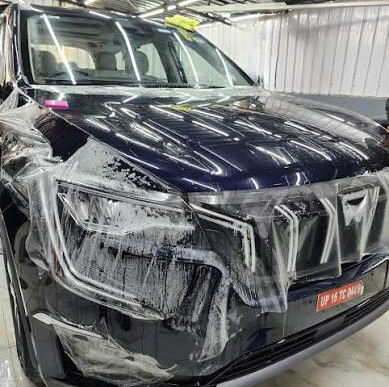
If you've just brought home a Mahindra XUV700, or you've been driving one for a while on Kerala's highways, you already know it's not a small car to protect. It's tall, wide, and carries a lot of painted surface area — bonnet, front bumper, fenders, and those muscular wheel arches all sit right in the line of fire from stone chips, monsoon grit, and the kind of bumper-to-bumper traffic that comes with NH544 and NH66.
The question we hear most often at our Irinjalakuda and Mannuthy studios isn't whether an XUV700 needs paint protection — most owners already sense that it does. It's which protection makes sense: PPF, ceramic coating, graphene coating, or some combination of the three. Having worked on a number of XUV700s ourselves, we've noticed the same handful of concerns come up again and again, and this guide walks through them honestly.
Why the XUV700 Needs a Slightly Different Approach
A few things about this specific SUV change how we think about protecting it, compared to a hatchback or sedan:
Its height and panel size. The XUV700's tall bonnet and boxy front end take a direct hit from road spray and flying debris on the highway — there's simply more painted surface exposed at grille height than on a lower car.
Popular colour choices. A large share of XUV700s on Kerala roads are finished in dark shades — Napoli Black, Dark Grey, and deep blues — often paired with black cladding. Dark paint shows swirl marks, water spots, and fine scratches far more visibly than lighter colours, which changes the calculus around gloss retention and wash-induced marring.
Ground clearance and cladding. The SUV's higher stance and body cladding mean lower panels, sills, and wheel arches take more splash-back from Kerala's laterite mud and monsoon runoff than a sedan would.
Curved surfaces. The sculpted bonnet lines and wraparound headlamp housings are more demanding to wrap cleanly with PPF than flat panels — installer skill matters more here than on simpler body shapes.
None of this means the XUV700 needs anything exotic. It just means the usual questions — PPF or ceramic, full body or partial, one-time or combined — deserve XUV700-specific answers rather than generic ones.
Option 1: Paint Protection Film (PPF) for the XUV700
PPF is a clear, self-healing TPU film applied directly over the factory paint. For the XUV700, it's most valuable on the panels that take the hardest physical hits:
Front bumper and grille surround
Bonnet and front fenders
Side mirror caps
Door edges and lower rocker panels (where cladding doesn't already cover the paint)
Because PPF is a physical barrier film rather than a chemical coating, it's the only option here that genuinely resists stone chips — a real concern for a vehicle this size doing regular highway runs. The self-healing property (minor swirl marks and light scratches disappearing with mild heat, like a warm-water wash or sunlight) is particularly useful on an SUV that gets driven daily rather than garaged.
Full-body PPF is a bigger investment than a partial front-end kit, and that's a genuinely relational trade-off rather than a fixed number we can quote generically — it depends on coverage area, the PPF brand chosen, and whether cladding and interior trim need to be removed for a clean edge finish. We work with Cosmo, Avery Dennison, Garware, Ultraguard, ALP, and Rodim films, and coverage level is usually the decision that matters more than brand alone.
Option 2: Ceramic Coating for the XUV700
Ceramic coating is a liquid polymer that chemically bonds to the clear coat, adding hydrophobic (water-repelling) behaviour and a harder, more chemical-resistant surface than factory paint alone. On an XUV700, this addresses a different set of problems than PPF does:
Hard water spotting — a genuine issue with Kerala's borewell water in many areas, which leaves mineral deposits that etch into unprotected paint over time
Gloss depth on dark colours — ceramic coating tends to deepen the finish on dark paint, which matters given how many XUV700s are finished in black or dark grey
Easier washing — the hydrophobic surface sheds monsoon mud and laterite dust more easily, reducing the friction (and swirl-mark risk) of frequent washing
What ceramic coating does not do is stop a stone chip. It's a surface hardener and gloss enhancer, not a physical shield — which is exactly why many owners pair it with PPF on the most exposed panels rather than treating the two as competing choices.
Option 3: Graphene Coating for the XUV700
Graphene coating is a newer evolution of ceramic technology, built around graphene oxide rather than pure silica. In practical terms for an XUV700 owner, the differences that tend to matter are:
Better heat dissipation — relevant for a dark-coloured, tall vehicle that absorbs more heat sitting in direct Kerala sun
Slightly better resistance to fine scratching during regular contact washes
Comparable hydrophobic performance to ceramic, with marginally better longevity claims from most manufacturers
Graphene generally sits at a higher price point than standard ceramic coating, and whether that premium is worth it depends on how the vehicle is used — a daily-driven XUV700 parked outdoors gets more value from the heat and durability benefits than one that's largely garaged.
PPF vs Ceramic vs Graphene: A Balanced Comparison
If you're weighing these options in general terms rather than XUV700-specific ones, our PPF vs Ceramic Coating comparison covers the broader trade-offs. For this SUV specifically, here's how the three stack up:
| Concern | PPF | Ceramic Coating | Graphene Coating |
|---|---|---|---|
| Stone chip protection | Strong — physical barrier | None | None |
| Swirl mark / gloss protection | Moderate | Good | Good to very good |
| Hydrophobic / easier washing | Minimal on its own | Strong | Strong |
| Heat resistance | Not applicable | Moderate | Better |
| Self-healing | Yes (film only) | No | No |
| Typical installation time | Longer (precision fitting) | Shorter | Shorter |
None of these three is objectively "better" in isolation — they solve different problems. PPF protects against physical damage; ceramic and graphene protect gloss, ease of maintenance, and chemical resistance. For an XUV700 specifically, many owners in our experience end up choosing PPF on the front-facing panels most exposed to highway debris, combined with ceramic or graphene coating over the full body for wash-ease and gloss retention — rather than picking one and skipping the other entirely.
Kerala-Specific Factors Worth Weighing
A few realities of driving an XUV700 in this region should factor into whichever option you lean toward:
Monsoon exposure: Extended monsoon months mean more time with wet, mud-laden roads. Both PPF and ceramic/graphene coatings make post-monsoon washing considerably easier, but only PPF prevents the physical pitting that comes from flying grit on the highway. Our monsoon car care guide covers general upkeep during this period in more depth.
Hard borewell water: If your regular wash water comes from a borewell rather than treated municipal supply, ceramic or graphene coating meaningfully reduces mineral spotting compared to unprotected paint.
Coastal salt air: For XUV700 owners closer to the coast (Guruvayoor, Chavakkad direction), salt-laden air accelerates oxidation on unprotected paint and metal trim — a relevant factor when deciding on full-body versus partial coverage.
NH544 and NH66 highway use: Regular highway commuting between Irinjalakuda, Chalakudy, and Kodungallur is the single biggest argument for PPF on the front end specifically, regardless of what you choose for the rest of the vehicle.
Heat and direct sun exposure: Given how many XUV700s are finished in dark colours, our Kerala car heat mitigation guide is worth a read if your SUV spends most of its time parked outdoors rather than in shade or a garage.
Our Experience Working on XUV700s
We've installed both PPF and ceramic/graphene coatings on a number of XUV700s at our Irinjalakuda and Mannuthy studios. The recurring pattern we see is that the curved bonnet and wraparound headlamp design need careful, patient film work to avoid visible edges — it's not a car where a rushed installation looks acceptable. On the coating side, the popularity of dark colour options among XUV700 owners in this region is exactly why so many customers ask us about gloss enhancement alongside protection, not protection alone.
A Quick Checklist Before You Book
Whichever direction you're leaning, these are worth confirming with any installer before committing your XUV700:
Ask which panels are included in a "full front" or "partial" PPF package — grille surrounds and mirror caps are sometimes quoted separately.
Ask whether cladding and trim are removed for the install, rather than taped around — this affects how clean the edges look on the XUV700's curved surfaces.
Confirm the film or coating brand being used, rather than accepting "premium PPF" as a description on its own.
Ask how the studio handles the wraparound headlamp housings specifically — this is one of the trickier areas on this model.
Clarify aftercare instructions for whichever option you choose, since correct curing time and first-wash timing affect long-term results.
Frequently Asked Questions
Is PPF or ceramic coating better for a Mahindra XUV700? Neither is strictly better — they protect against different things. PPF is a physical film that resists stone chips and road debris; ceramic coating is a chemical layer that improves gloss, water resistance, and washability. Many XUV700 owners use both together on different areas of the car.
Do I need full-body PPF on an XUV700, or is partial coverage enough? That depends on how the vehicle is driven. Owners doing regular highway commutes benefit most from at least front-end coverage (bonnet, bumper, fenders, mirrors), which takes the majority of stone-chip impact. Full-body coverage adds protection to the remaining panels but is a larger investment to weigh against your usage pattern.
Does graphene coating last longer than ceramic coating on an XUV700? Graphene coatings generally claim comparable or slightly longer durability than standard ceramic coatings, along with better heat resistance — relevant for a tall, dark-coloured SUV that sits in direct sun. Actual longevity in both cases depends heavily on wash habits and parking conditions rather than the coating alone.
Can PPF and ceramic coating be applied together on the same car? Yes — this is a common combination, not a conflict. PPF is typically applied to the most exposed panels first, and ceramic or graphene coating is then applied over the entire vehicle, including the PPF-covered areas, for added gloss and hydrophobic performance.
How does Kerala's monsoon affect the choice between these options? Extended wet-season driving increases both stone-chip risk (from wet road grit) and washing frequency (from mud and laterite dust). This combination is part of why many Kerala-based XUV700 owners lean toward pairing PPF on the front end with a full-body ceramic or graphene coating, rather than relying on either alone.
Does the XUV700's body cladding make PPF installation harder? The cladding itself isn't wrapped in PPF, but it does affect how film is fitted around adjoining painted panels — particularly at the wheel arches and lower doors. A careful installer will typically remove or mask the cladding edge properly rather than cutting film against it, which affects how seamless the finish looks over time.
A Note on Making the Right Choice
There's no universal answer here — the right combination depends on how much highway driving you do, whether your XUV700 is garaged or parked outdoors, your local water source, and honestly, your budget. What we'd recommend against is choosing based on price alone, particularly with PPF, where installation quality on a vehicle with this many curved surfaces makes a real difference to how the film looks and lasts.
If you're weighing your options, our team at Menora We2 can walk you through what makes sense for your specific vehicle, usage, and budget in person. You can get in touch with us here to discuss your XUV700.
Sebi Jacob is the founder of Menora We2 Auto Detailing Studio in Thrissur, Kerala, specialising in paint protection film, ceramic coating, graphene coating, paint correction, and professional auto detailing. He works daily with vehicles facing Kerala's long monsoon, coastal air, and demanding highway conditions.